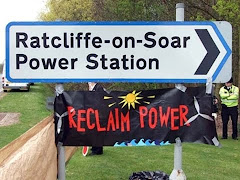
I went to protest against the meeting of the G20 in London last week. I listened to a samba band, chatted to lots of lovely random people, ate slightly squashed sandwiches in the sunshine and was nowhere near where Ian Tomlinson died.
To briefly fill you in if you’ve been on another planet for the last week or so; someone who had nothing to do with the protests was walking home through it all, and was hit and pushed over by a police officer in riot gear. Video of this happening was recorded on at least two different cameras by other people nearby - which you can see here and here - and we’ll probably eventually see footage from CCTV cameras in the area too. It is pretty clear that it’s assault. He died in the street soon afterwards of a heart attack, and it seems that police officers actively hindered the efforts of a medical student to give him first aid, and then delayed an ambulance attending the scene to resuscitate him.
Plenty has already been written about the G20, the protests against it, the police tactics used and the press coverage of it all.
The one thing I don't think is being said enough at the moment is that the tactics and behaviour of the police last week were entirely routine. Just about every major protest I've ever been on, as well as many smaller ones, has been policed in more or less this way – in fact you can always spot a first-time attendee at any protest because they are the only people still expressing astonishment at what they see police officers do.
Kettling, crap (i.e. obviously arbitrary) arrests, police provoking violence, hitting people on the ground with batons, shoving very hard with shields and intimidating people who aren’t even involved happens at almost every protest. Lots of us simply expect it now. Most people who are attacked by police officers never bring a complaint - it’s not usually possible to identify individual officers after the event, and onlookers are often busy being attacked themselves rather than filming what is happening. But it happens all the time.
I’ve seen countless protesters with head injuries, because lines of police often raise their batons above their own heads to beat indiscriminately down on crowds of people, after pushing them back so they’re packed too close together to be able to avoid the blows.
Every time there is any liaison between protesters and police, we ask them to ensure that all officers’ identification numbers are kept clearly visible precisely so that we can hold them accountable for this behaviour. Every time they fail to do this.
They actively prevent people from recording their actions by filming or taking photos. Even people who realise that media coverage is biased often have little idea how profound and widespread the bias is. Unprovoked and disproportionate police violence is massively under-recorded and under-reported, preventing any individual case from being seen in its wider context of routine police brutality.
If Ian Tomlinson had not died last week there would have been no investigation. If there had been no footage of the assault then it would have been assumed that the police had acted reasonably, and the attack would have become one of thousands of police assaults which go completely ignored every year. It’s a matter of time before someone else dies, and a matter of luck whether anyone will manage to get clear footage of it next time.
I hope the investigation into Tomlinson’s death doesn't allow everyone to narrow the focus of discussion to just this one fatal incident. It's high time that the whole nature of the role of policing at protests is called into question and that some real accountability is forced on the police.
Friday, 10 April 2009


Wednesday, 8 April 2009
Turn On, Plug-In, Opt Out!
 Starting today, Google will be collecting information on the web pages you view in order to target advertising at you.
They don't need your permission - if you don't opt out then the law apparently allows them to assume your "implied consent". They also have little obligation to make sure you know they're doing this, which one might think would tend to make it rather difficult for you to choose to consent to it even if you wanted to. Anyway, now you know, so now you can choose to opt out.
In fact I hardly ever see any advertising on the internet any more since I got the almighty Adblock Plus for Firefox. Honestly, even if you're the least technical person in the universe, if you use Firefox then click here, click on "Add to Firefox", and let it install. It will tell you to restart Firefox, and then you need to click on a filter to tell it which ads to look for - pick the first US one if you're in an English-speaking country. That's it.
It's easy, I promise it won't go wrong, and I swear I only see advertising on the internet now when I use someone else's machine which doesn't have Adblock installed. Then everything is suddenly plastered in the stuff, which the normal user of the machine usually insists they "never really notice". If they really don't notice that amount of junk on the screen all the time then advertisers must practically have electrodes implanted directly into their subconscious. Give yourself a couple of weeks without the distraction of incessant advertising, and then see how cluttered and shouty other people's experience of the internet begins to seem.
Google, however, will still be collecting information about the pages you view in order to target advertising at you, even if you're not actually seeing the ads. It's the data collection aspect that I object to most, so I still want to opt out of their intrusive scheme and stop them virtually spying on me in the first place.
Trying to find out how to do this involved having to read pages and pages of corporate drivel about how to "improve your online experience" by letting Google show you "the most useful and relevant ads online" which can be "tailored to your interests" with a system based on "transparency" and "choice".
To save you the sheer annoyance, click here, and then click on the big blue thing that says "Download the advertising cookie opt-out plugin". If you have more than one browser then you'll need to do this in all of them, e.g. you need to do this once in Firefox, once in Internet Explorer, and once in Chrome or whatever else you use for browsing the internet. (If you're not sure then you probably only need to do it once.)
After that they should bugger off and leave you alone, at least until the surgeons call round to give you that lobotomy you've implied your consent for by failing to let them know you didn't want it.
Subscribe to:
Posts (Atom)